What is this article talking about?
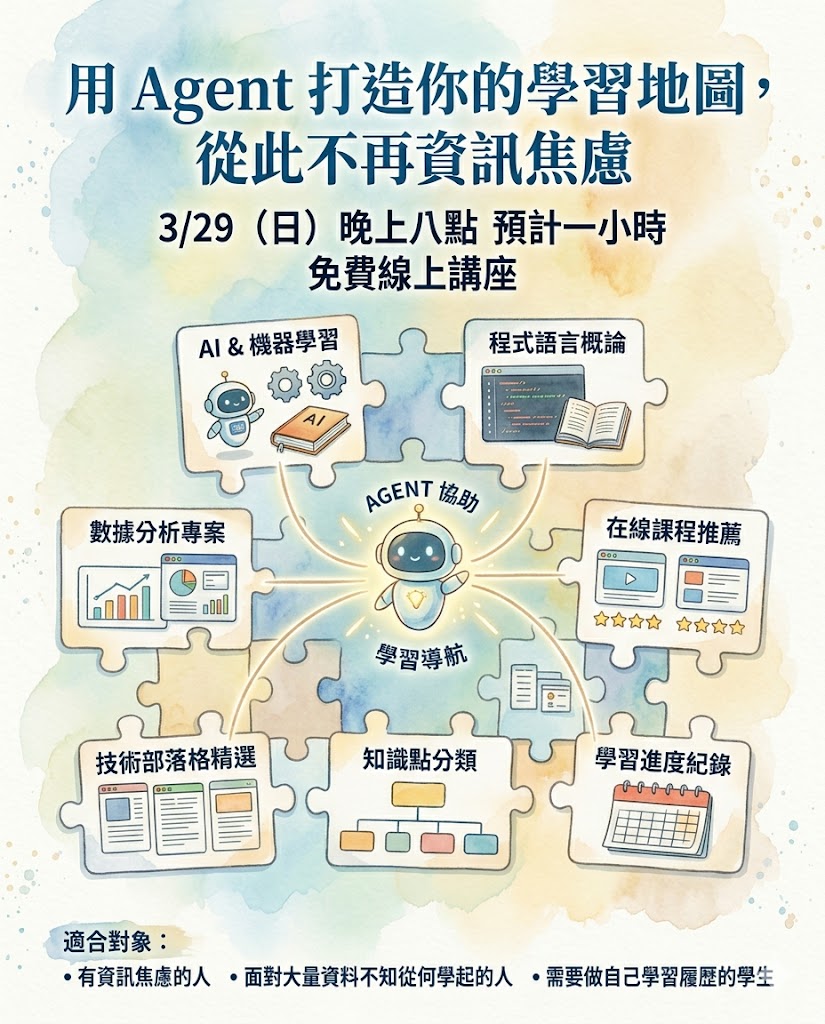
The root cause of information anxiety is often that the information is not organized into routes. It is rare to find a simple lack of information. This article summarizes the complete content of the lecture "Use Agent to Build Your Learning Map": how to gather learning materials scattered everywhere into a visible map, and the three-layer application from learners, teachers to dynamic rule judgment. Who is
· People who are faced with a lot of information and don’t know where to start.
·Students and career changers who need to prepare their own study resume
· Teachers who want to use Agent to manage teaching context and help students make customized lesson plans
· Four things to answer when learning a map, and how to dismantle the skill tree
· Three-layer application cases: learning map, teaching context, automatic scheduling
· A three-level skill tree practice that can be started tonight
Four things to answer when learning maps
The way many people learn AI is to collect articles, videos, tool lists, and course links at the same time. The more information piles up, the less they know what to do next. What is missing at this time is a map, which must be able to answer four things: where am I now, what will I learn next, what abilities will I get after completion, and how often should I review it.
When you give the topic to AI, don’t just ask it to list a bunch of resources. That’s just moving the favorites. A better way to ask is to ask it to be split into skill trees:
Every node has exercises and acceptance, which is more traceable than simply watching instructional videos. Vague anxiety will turn into small nodes that can be completed one by one.
The first level: learners, create their own learning map
The core concept of this layer is "your files are your system". You don't need to be able to write programs. As long as you organize your knowledge, experience, and rules into documents, the Agent can read, execute, and help you do things. The actual approach is divided into three steps:
Write your positioning, background, and judgment criteria into a document so that the Agent can get to know you first.
Let Agent help you capture, arrange, and classify scattered collections, notes, and teaching links.
Execute in your own way: let the Agent run your process, there is no need to copy others.
After completing it, you will get a learning resume: what you have learned has become visible results. This is especially useful for students. Topics, exercises, and experiences in the study process are all organized into a map that can be displayed, which is more than a stack of favorites that no one reads.
Study status should also be recorded. Use Markdown or a knowledge base to save the goals, resources, exercises, experiences, and next steps for each topic. When the Agent reads these records, it can help remind you of the next step and help you organize your review. Learning no longer relies solely on current enthusiasm, but has an external system that can be continued.
Second level: Teacher, use Agent to manage teaching context
The same method is switched to the teacher, and the object of organization becomes the teaching context: put your own briefings, lesson plans, and teaching logic into the folder, continue to feed new teaching materials and reference materials, and put the students' situation and progress into it.
As time goes by, Agent understands you better and better. When new data comes in, it can directly produce customized lesson plans based on your past teaching habits and the context of this class of students. Which ability node each class corresponds to, what works students complete, and how to extend after class are all clearly marked, making it easier for students to know why they want to learn this section.
The characteristic of this system is that it will become smarter the more you use it. This is the difference from a static database. And the data is all stored on your own computer, so you don’t have to worry about changing platforms any day.
The third layer: dynamic rules can also be handed over to Agent, case of scheduling system
The first two layers deal with static data, and the third layer demonstrates abstract rules and complex judgments. I helped a friend create an automatic scheduling system: I wrote the company’s scheduling rules into a skills package, including who cannot take vacation at the same time, the priority of vacations, and how to deal with special circumstances, all clearly stated. After that, everyone just needs to throw in the vacation they want to take, and the Agent automatically calculates the optimal solution and directly generates an Excel sheet.
Make the rules into a skill package, and the Agent can execute your SOP. Large companies buy the system, while small companies and small teams only use Agent. This is the same principle as learning a map: write "judgments that only you know" into files that AI can read.
How you can practice: first draw three layers of skill trees
The smallest exercise you can start tonight: pick a topic you are learning and ask AI to help you split it into a three-layer skill tree.
- The first layer of core capabilities: This theme breaks down into three to five capability nodes.
- The second level of practice tasks: Design a completed small exercise for each node.
- The third level of acceptance results: after each exercise is completed, what visible output will be left.
- Save this skill tree as a file, and come back to update the status and experience every time you complete a node.
This small map will be more useful than endless collection of resources. Once the files accumulate and let Agent read the entire folder, your learning map will begin to grow on its own. If you want to know which course ability nodes this personal map is connected to, you can check itMy AI Course Map; Ready-made map learning skills package is includedSkill Pack Download Pagecan be taken.