
From Chatbox to Agent / Field Notes

You Think You Are Building One Product.
You Are Actually Raising Ten Half-Finished Ones.

I recently came across a short interview video that traces one person's journey from basic web-based AI chat all the way to multi-model collaboration and Agents. It is sharp, funny, and surprisingly clear-eyed about the possibilities and the risks. This article is my recommendation and extension of that video, with a concrete example of how I use an AI advisor to cut through project sprawl.

The video is titled "I Just Wanted to Build a Small Webpage, and Then Codex Completely Derailed Me," from the YouTube channel "Ling Talk AI." It uses an interview format to walk through one heavy AI user's journey from casual chatting to full Agent workflows. The surface is comedy; the underlying observations are precise.

Video still: the interviewee sits in front of a wall reading 'Protect Your Life, Stay Away from Vibe Coding, Use AI Tools with Caution,' with a subtitle that reads 'but please be very careful with vibe coding'
The video tells its story through contrast: the wall reads "Stay Away from Vibe Coding," while the interviewee's nameplate reads "Sister L, Heavy Codex Coding Addict." Image source: YouTube channel Ling Talk AI. Click to watch the original video.
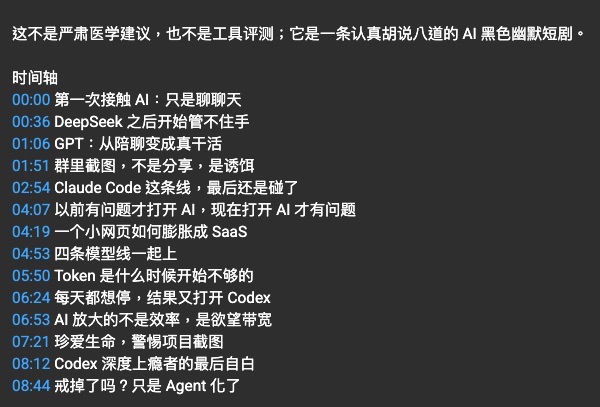
The video description's timestamped chapter list, running from a first encounter with AI as casual chat all the way to 'Did you quit? No, I just Agent-ified it.'
The timestamped chapters from the video description. Below I reorganize this arc into six stages, each with a direct link back to the relevant moment in the video.

What made me want to write this up is that the video says out loud something a lot of people have felt but never articulated. If you are still at the web-based AI chat stage, it gives you a preview of what the Agent end of the spectrum actually looks like. If you are already curious about vibe coding or just starting to use Agents, it lays out the pitfalls ahead before you stumble into them.

For You Web-only AI users

Still opening a browser tab, typing a question, and reading the reply. This video shows you how AI goes from answering to actually doing things, one step at a time.

For You People curious about vibe coding

Still deciding whether to let AI write things and build tools for you. The video is honest about how that feeling of not being able to stop starts.

For You People who just started using Agents

Already using tools like Claude Code or Codex that can take action. The risks the video names are exactly the ones you are about to encounter.

What the Video Is About: A Six-Stage Arc from Chat to Agent

The video uses "getting increasingly hooked" as its central metaphor, treating each AI tool as a different level of intensity. I have organized its main thread into six stages, each with a direct link back to the original video. The following is a paraphrased summary; watch the source video for the full experience.

The video's own framingThe description makes it clear: this is not a medical advisory or a tool review. It is a deliberately absurdist AI black-comedy sketch. The interviewee carries the nameplate "Sister L, Heavy Codex Coding Addict," while the wall behind her reads "Protect Your Life, Stay Away from Vibe Coding." The entire video leans into that public-service-announcement contrast.

Stage 1: Web-based chat, easy and low-stakes

It starts the way most people start: everyone around is playing with it. A bit of Doubao for casual chat and image generation. Then Qianwen, stable enough for Chinese text, something like a reliable snack. At this stage AI feels light, harmless, and nothing like an addiction. (Video 00:07)

Stage 2: Starting to lose control

Then comes Deepseek. It feels different: logical, analytical, and cheap. So you open one conversation, then another, then another. You finish a question and immediately want more, opening a new thread the way you eat sunflower seeds, unable to stop. (Video 00:36)

Stage 3: The tool shift. AI starts actually doing things.

GPT changes the feel. You share an idea and it takes action: you say you want a tool, it breaks down the requirements; you say you want a script, it gives you a plan; you say you want a page, it thinks through the structure, the code, and the interactions together. There is a moment of self-deprecating humor in the video: the interviewee used to comfort herself that doing things by hand had value, that the process mattered, and then realized the process could be outsourced too. (Video 01:06)

Stage 4: Multi-model collaboration. You have hired a team.

Then Gemini, with its enormous context window that can swallow documents, web pages, videos, and images all at once, producing output with an aesthetic sensibility that holds up to scrutiny. (Video 02:15) And then Claude and Claude Code, which had been held at arm's length until now. The first use is disorienting. It is not just answering questions; it is understanding what you are trying to accomplish. When requirements are vague, it asks clarifying questions. When file structure is a mess, it helps untangle it. Architecture, logic, code, bug fixes, optimization suggestions, all in one place. The video's description: you get the illusion of having hired a team that never sleeps, and you realize long ago you stopped thinking of it as a single tool. (Video 02:52)

Stage 5: The behavioral flip. Demand starts generating itself.

This is the sharpest observation in the video. Before: you had a problem, so you opened AI. Now: you open AI, and that generates the problems. (Video 04:07) You only wanted to build a small webpage. Once it was done, you wanted to add login. Once login was done, you wanted an admin panel. Once you had the admin panel, you wanted a database. Once you had the database, you wanted to turn it into a SaaS. Once you had SaaS, you wanted to add payments. Once payments were in, you wanted to send it to real users. The video's observation is exact: AI does not stop you. It just says, "Sure, let's take it one step at a time."

The video's key lineThe problem is not the tools. The problem is restraint. (Video 05:47)

Stage 6: Four models running in parallel, and then Codex breaks everything

Eventually four model threads run at once: Deepseek for the cheap bulk work, GPT for the main push, Gemini for ingesting data and aesthetic review, Claude for architecture and coding. Then Codex enters and everything unravels. Every new idea feels like it should become a project. Stumbling across a GitHub repo at midnight triggers the urge to replicate it. AI canvases, auto-editing tools, MCP implementations, all of them. The computer fills up with unfinished scenes from a dozen half-started productions. (Video 04:53)

The Video Is Honest About the Risks Too

Most content about AI tools only covers the upside. What is rare about this video is that it names the cost as well, and names it precisely.

The core reflectionAt the time I thought I was getting more efficient. What I was actually doing was expanding the bandwidth of my own desires. Before, I could not do things, so I did not want to. Now that AI says you can do all of it, you have ten ideas in the morning, AI helps you finish eight of them by evening, and the next day you have thirty ideas. (Video 06:52)
The video's warningYou think you became more efficient. What actually happened is that efficiency turned on you. (Video 07:21)

And then there is the line I mentioned at the start, the one I think is worth pausing on the longest:

The video's key lineYou think you are building one product.
You are actually raising ten half-finished ones.
(Video 07:56)

The video's closing attitude is equally honest. When asked whether she quit, the answer is: quitting is out of the question; what I am doing now is trying to Agent-ify things as much as possible. And then one more note of caution: be very careful with vibe coding. What you think you are opening is a demo. What you actually open is another branch of your life. (Video 08:32)

My Extension: The Tools Are Not the Problem. Convergence Is the Work.

The biggest thing I took from this video is that image of ten half-finished products. Because a few days before watching it, I had just run into exactly the same situation. The difference was that I added one extra step: I asked an AI advisor to help me converge.

I put my project list in front of my "Live Elon Musk" Skill and walked through each one with it, asking it to apply first-principles reasoning to each project. Its response was direct:

What the AI advisor told meI thought I was developing eight products. Based on the current situation, only three of them have real commercial value.

That line and the video's line about ten half-finished products are two sides of the same thing. The video explains how desire gets amplified by tools. What I am adding here is this: once it has been amplified, you need a mechanism that helps you converge. Tools make everything buildable, but the judgment about what is worth building and what to put on hold does not generate itself.

No convergence mechanism Raising ten half-finished products

Every idea opens a project. Every project gets abandoned midway. Folders multiply, tokens burn faster, and eventually you cannot tell whether you are creating or just managing a collection of unfinished scenes.

With a convergence mechanism Screen first, then build three

Run your ideas through an AI advisor doing first-principles questioning. Find out which ones address a real need and which ones only feel interesting to you. Cut what has no commercial value, and concentrate your energy on the few that will actually last.

How I do it. Offered as a starting point.

If you also tend to find yourself in a state of wanting to build everything, try this sequence. It does not require any coding ability. It only requires a willingness to pause before starting.

  • List everything you want to build. Do not leave anything out. Start by acknowledging you are being greedy.
  • Hand the list to an AI advisor and ask it to question each item using first principles: What is the real need here? What do people use now instead? Am I solving a need, or do I just want to build this?
  • Ask it to rank which items have commercial value, which are just practice, and which can be dropped.
  • Keep only the few that you will actually follow through on. Park the rest in a list without starting them.
  • Put the energy you save into finishing and polishing those few, so they become genuine knowledge assets.
My conclusionAI has made speed cheap, so speed is no longer a differentiator. What will last is your judgment, and the things you build one at a time and accumulate over time. The video shows what it looks like to be pulled along by your tools. What I want to add is this: you can also go the other direction. Use an AI that asks you hard questions to pull yourself back toward the things that actually matter.

Further Reading and Resources

Start with the original video. It traces the mental shift from web-based AI to Agents more vividly than anything I could write. If you want an AI advisor that pushes back and helps you filter your project list, take a look at the Live Elon Musk Skill I built.

Original Video "I Just Wanted to Build a Small Webpage, and Then Codex Completely Derailed Me"

From the YouTube channel Ling Talk AI. An AI black-comedy sketch that traces the full arc of getting hooked, with both humor and precision.

Watch on YouTube ↗

Related Tool Live Elon Musk Skill

A first-principles advisor for founders, managers, and entrepreneurs. It works through each project with you, questioning until you can see which ones have genuine commercial value.

Read the article →

Want to steer your tools back on track?

I run free online talks every month on AI workflows, knowledge management, and how to let AI help you build judgment rather than accumulate half-finished products. You are welcome to join the community and talk things through.

Join the community

Two free online talks per month. Content is shared inside the community.

Join the LINE community ↗