What is this article talking about?
This article compiles the complete process of the "Parent-Child Storytelling AI Workshop". This activity is a collaboration between myself and teacher Chen Yingjun with a special education background. Most of the parents present that day had never told stories, written scripts, or made picture books or posters. Two hours later, everyone turned their own family stories into visible works. The methods and prompts are all in this article. Who is
· My child is already using AI, but I haven’t started yet. I want to find a parent with a warm entrance.
· People who want to record their daily interactions and turn them into memories for parents and children together
· Teachers and organizations who have a good method and want their service recipients to actually use it
· Four keys to parent-child guidance in the Red Tomato Agreement
· Two sets of prompt words that can be directly copied: story draft and illustration three-version design draft
· The secret of live-action movie posters and how to grow five finished products from one story
Start with the Red Tomato Protocol
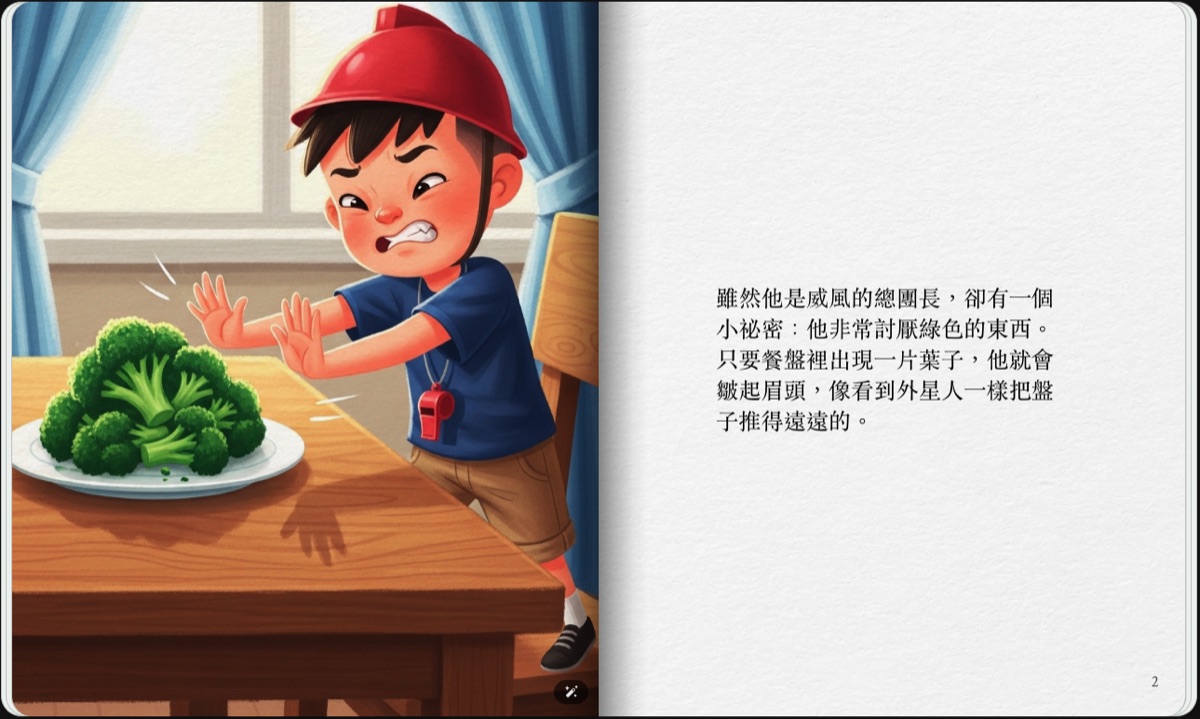
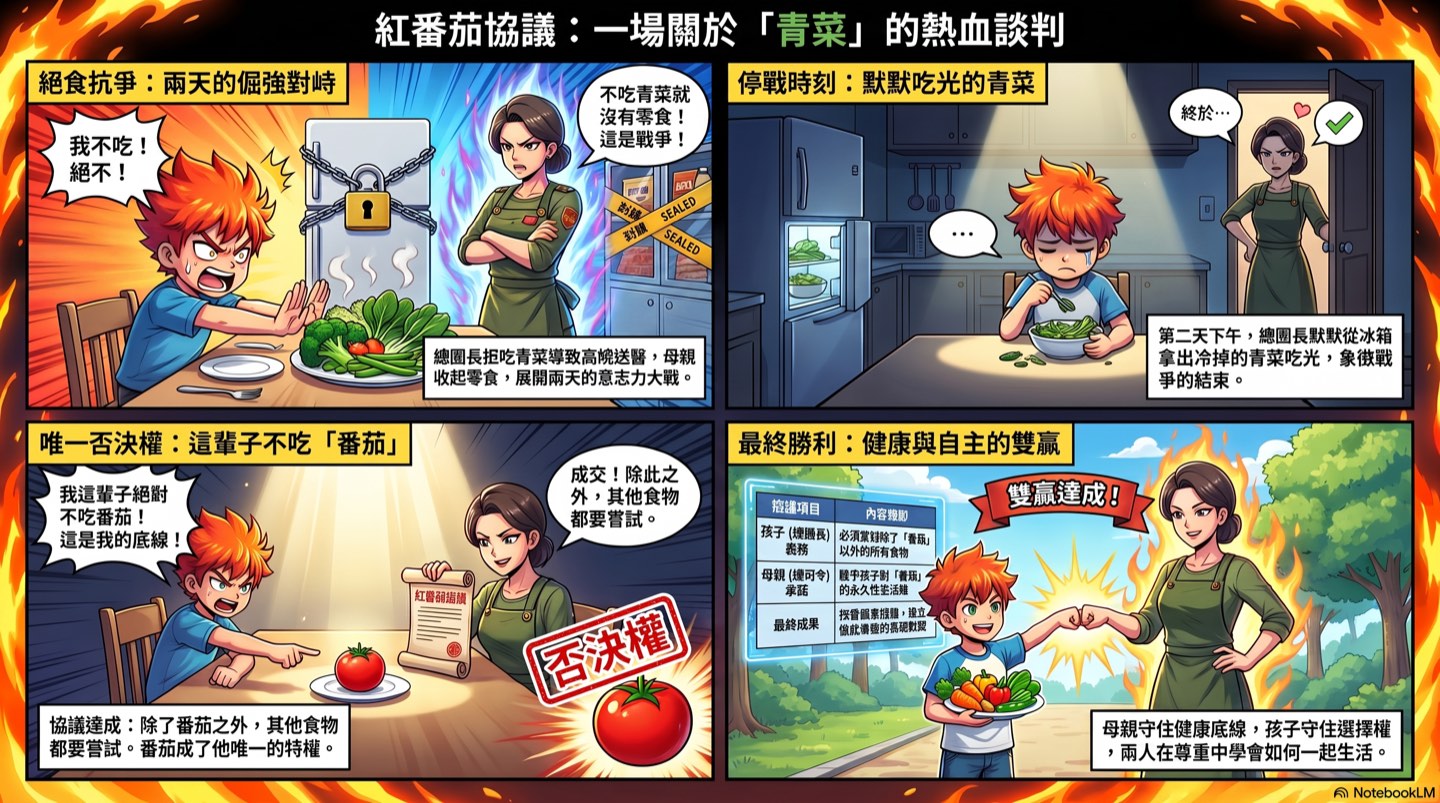
The workshop started with teacher Chen Yingjun’s true story "The Red Tomato Agreement": a child had a severe partial eclipse and only ate meat, suffered from chronic constipation and even went to the emergency room in the middle of the night. The mother made a rule that "green vegetables must be eaten", and the child launched a hunger strike, and the two faced off for two days. After the child gave in, the two sat down to negotiate. The mother said, "There is one food that you can never eat in your life. That is your right." The child immediately answered "tomato." From then on, tomatoes became the only food in his life that he had veto power over, and that agreement became the longest tacit understanding between mother and son.
This experience was later extended by the teacher into a set of guidance methods for parent-child communication, which can be broken down into four key points:
Health is a mother’s uncompromising principle. Children need to know first that some things are serious.
Give your child the right to "not eat forever", and he will no longer be the only one who is asked.
After the confrontation, we sat down to talk and the rules turned into promises that both parties were willing to abide by.
In the end, what remains more than winning or losing is a tacit understanding of mutual respect and being able to live together.
It can be used in vegetables, and it can also be used in various parent-child interactions in life. If you think the method makes sense, but don’t know how to apply it to your own situation, this is where AI can help: tell the AI where you are stuck, and let it accompany you to turn the teacher’s method into an agreement that belongs to you.
Step one: Tell your family’s affairs into a story
The workshop’s script prompts have a key design: when there is insufficient material, the AI must ask questions first and brainstorming is prohibited. It will ask who the protagonist is, where the conflict is, how the child usually handles it, how the parents handle it, how it ends, what the real trouble is, what agreement you want to make with the child this time, and what reinforcements the child gets in the agreement. Reinforcers can be food, stickers, points, or they can be praise, being seen, having a choice, and being respected.
Pay attention to the lines of writing requirements: Don’t blame the children, and parents don’t have to be perfect. This set of prompts takes care of not only the finished product, but also the mood of the storyteller. The full version of the prompt is atClassroom Briefing Pagecan be copied in its entirety.
The second step: first produce three versions of the design draft, and parents and children can choose together
After the story goes well, don’t rush to make pictures. Ask AI to design drafts for three single pictures in completely different styles: each one contains which scene to draw, composition, emotional atmosphere, a short picture sentence, and prompt words that can be used directly to draw pictures. The three styles are required to be very different, and just changing the color does not count.
The process of selection is an activity in itself. Don't just ask which picture is beautiful, you can ask your child: "Which picture is most like the story we just told?" "Which picture is most like the feeling you had at that time?" The selection of the image itself is telling the story again.
The secret to live-action movie posters: Keep yourself, just change the surroundings
The climax of the workshop is to use photos to make live-action movie posters. There is only one trick: Don't move the character, just change the surroundings. Ask the AI to retain the facial features, expressions, age, and true temperament, while changing the clothes, scenes, lighting, props, and movie atmosphere. The single protagonist is given three views (front, side, and back), and with enough AI references, he can change his actions while still looking like himself; for a family portrait of three to five people, just use a group photo to modify it, and the more people there are, the easier it is to make things messy. First ask for three movie versions at a time, and parents and children can choose together.
One story, five kinds of finished products.
The demonstration that day used the same "Red Tomato Protocol" to create five completely different finished products, each with corresponding tools and basic instructions:
- Storybook: Use Gemini's storybook function to interactively turn pages and add AI reading. Remember to specify "the appearance of the protagonist must be consistent throughout the book".
- Four-frame comics: Using NotebookLM’s infographics, hot-blooded comic style plus dialogue bubbles, the structure is question, process, turning point, and ending.
- Picture book: Use the presentation function of NotebookLM, with one large watercolor illustration and less text on each page.
- Audio short film: Using NotebookLM's video summary, the narration is warm, the pace is slowed down, and the end of the film stops at the sentence I want to give to my children.
- Movie poster: Use ChatGPT to combine real photos.
The key is to process it in sections: write the story firmly first, and then decide which medium to convert it to. The quality will be much more stable than asking the AI to complete it all at once. Moreover, this set of "borrowing expert methods" skills can be transferred to other places: If you can't read the parent-child academy's handouts, ask AI to translate them into words that parents can understand; when you see the skills shared by the teacher, ask AI to organize them into steps that can be tried next week according to your family's situation; AI will first organize the information and plans, and finally bring them back to the teacher, and the discussion will be more specific.
In the AI era, parent-child diaries will become data
The home assignment of the workshop is to write a parent-child diary: write down the incident, the child's reaction, how the parents handled it, how it ended, and the agreement they want to try next time. It’s okay if you don’t have a clue at the moment, just write it down first.
After the diary has been accumulated for a period of time, you can ask AI to help sort it out: where the child has made progress, where it has repeatedly gotten stuck, and where it can be adjusted. It doesn’t matter if you don’t know how to analyze. AI will first organize the information into key points. Parents will then take the organized content and ask professional teachers to read it together.
How you can start: Remember a small real thing first
Minimum viable start, can be done tonight:
- Write down a real little thing between you and your child today: a hurdle, an agreement, a progress, or a warm moment.
- Post it to ChatGPT and use the above prompt words to organize it into a short story. If the material is not enough, let the AI ask you.
- Ask AI to produce three versions of illustration design drafts, and let the children choose one to generate.
- Let the children change the characters, change the ending, and talk about "what is most like our home".
Starting from a conversation, you move from tool practice to family co-creation.